International House of Weddings

[A bit of a back story before Hurricane Katrina]

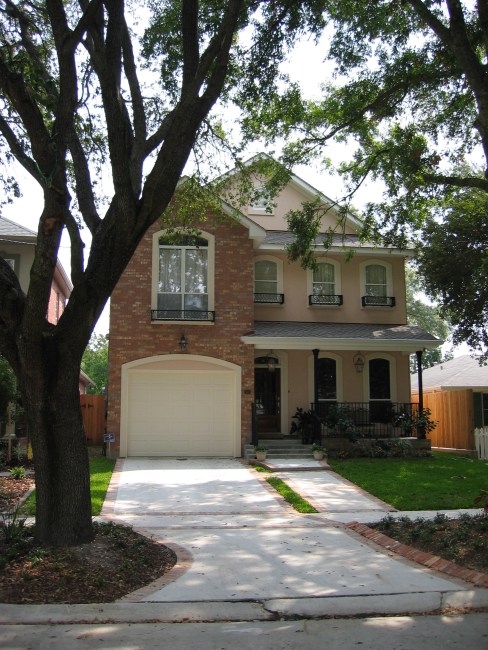
Steve and I had been house-hunting for a while.  We wanted something smaller, newer, and more centrally located in the Lakeview area of New Orleans.  In February 2004 we spotted a house under construction on Bellaire Drive.  It was a diamond in the rough, half-built but already gleaming.  I loved the flow of it, the spacious entry and grand staircase and big windows.  I heard it whisper, “This will be a place where your friends will want to come.”  We made an offer the next day, then spent several frantic, happy weeks making design choices to put our personal stamp on our first brand-new house.

Not one to be superstitious, I ignored all the cues.  On move-in day the builder greeted us with ominous words:  “Welcome to the house from hell.”  Subcontractors had not finished on time, but the moving van was on its way and we were here to stay.  As I stowed away the food I had brought from our old house, I dropped a glass jar of pickles on the hard floor.  Wiping up glass shards and pickle juice, I wondered if the sour smell might somehow cast a jinx upon the house.  Worst of all, the next day we received a call from Steve’s father in Indiana with terrible news.  “Your mother just passed away, Steve.”  Amid the packing for an unexpected trip to Indiana, I shuddered slightly at the strange circumstances.

Despite all that, we loved the house.  And so in January 2005 when a friend was looking for a place where he could marry his Lithuanian sweetheart, we said, “Have the wedding in our new house.”  And because the wedding was planned during Mardi Gras season, it became our first real party on Bellaire Drive.  We dubbed it the International House of Weddings.

A couple of months after the Mardi Gras wedding, our son Ted told us that he had a date with a girl from Panama who was visiting the U.S  His friend and co-worker, Jose Santamaria, wanted to introduce him to his niece Dayana.  Their mutual attraction overcame the language barrier and by May they were discussing marriage.  I was startled by the suddenness but not surprised.  Ted had never been happier in a relationship or more certain that this woman would be his partner for life.

Steve and I met Dayana the day before we left for a two-week vacation.  We both liked this bright and beautiful young woman.  As soon as we returned from our cruise at the end of May, the wedding date was set for July 23, 2005 and preparations began in earnest.  The deep hole in the backyard stared back at us and we pleaded with the swimming pool contractor to finish his work by mid-July.

Two days before the wedding, my nephew Scott and his wife Carla flew down from Indiana with my 95-year-old mother.  I wonder if the wedding would have happened without them—Scott running errands in an unfamiliar city, Carla organizing the dining room and prepping the food, my mother arranging bunches and bunches of flowers into their tall vases.  Once again the International House of Weddings stood ready for its special guests.  Even the pool had been completed the day before the wedding.

Carla and I sat at the dining room table on the morning of the wedding, eating an early breakfast.  Carla looked across the street and asked, “What is that hill in those people’s backyard?”  “Oh, it’s the levee,” I said.  “It’s what keeps the city dry.”  “What would happen if it weren’t there?” Carla persisted.  I laughed.  “We’d be underwater!”  And then we jumped into the heap of details to attend to on that unforgettable day.
012 6115 Bellaire before

The International House of Weddings on Bellaire Drive, July 2005

© Janice Shull
A Bridge From Then to Now

The world is a bridge.
Pass over it.
Do not build your dwelling there.
(Inscription on the Great Mosque at Fatehpur-Sikri, India)

Approaching the end of August each year I enter into a time of reflection on the anniversary of Hurricane Katrina and its aftermath. My family’s experience of this major disaster has become a defining feature of our lives. An indelible line is drawn through our memories: before and after Katrina. Trauma comes in many forms, and nearly everyone experiences sudden, unexpected change sometime in life. I share my version here with you because it is part of who I am, and because I still work to understand what happened then and where I am now.

August 27, 2005 was the last ordinary day of our lives in New Orleans. The city had been our home for thirty-one years, the place where Steve and I gave birth to and raised our two children, where we settled into three homes, made friends, established satisfying careers and fell in love with the city in the bowl beside the river. We had coped with many hurricane threats in those years, sometimes deciding to ride it out at home and other times getting on the road to safety. Along with most New Orleanians, we joked about “the Big One,” and assumed that the next hurricane would be like the previous one, interrupting our routine for two or three days, followed by fixing whatever had been damaged.

Katrina, however, became the “storm of the century.” The devastation it caused in New Orleans came primarily on the second day after the hurricane made landfall, when the storm surge from Lake Pontchartrain put pressure on the entire levee system in New Orleans. One after another, the levees were overtopped or broke apart from the pressure, until 80 percent of the city was underwater.

In May 2004 we moved from our home of seventeen years in New Orleans East to a new home on Bellaire Drive in Lakeview. Our street was the last one in Orleans Parish on the west side of town before you crossed into Jefferson Parish. The border between the two jurisdictions was a canal protected on the Orleans side by a steep grass-covered levee,  which we were assured had been recently strengthened to withstand a Category 3 hurricane. Later, investigative reporters uncovered the fact that inferior building materials had been used in a corrupt contract scheme.  The levee crumbled like stale cake when the storm surge pushed against it. Our house stood about two miles downstream from the breach. There would be no escaping the waters on Bellaire Drive.

As the reality of the flood sank in I found healing power in recording my thoughts and feelings in a journal. Every year I reread the entries and relive the moments, days, weeks, months, years that have accumulated since then. I read it not to weep or wallow in the past or wonder what might have been. I read it to find signposts. A place where we turned, or took some backward steps, or saw an arrow pointing us ahead. A bridge from then to now, a bridge that supports us through the times of remembrance and carries us onward.

P1000337

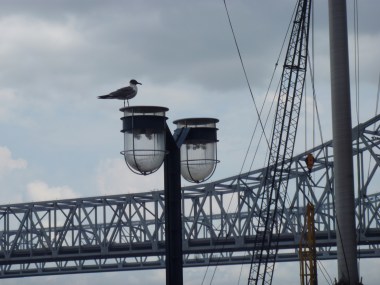
Detail of the Crescent City Connection


The Power of One

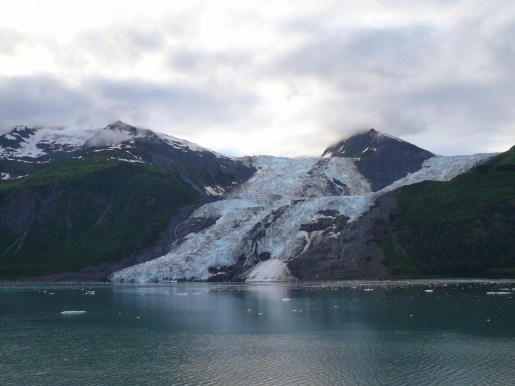
It’s hot here in Florida so I am thinking of something cool.  Alaska!  Ten years ago Steve and I traveled with good friends John & Susan to Alaska on a Celebrity cruise.  A National Park Service naturalist described for us in great detail the formation and movement of glaciers across mountains.  It made such an impression that I felt inspired to write a poem about it.  Whether one stands alone or joins with others, never doubt the power of One.

Strength to Shape a Mountain
(Reflection after Glacier Bay National Park naturalist’s talk)

It starts with one,
Six-pointed, crystalline, clear
Snowflake,
Which could melt on my tongue,
Or mesmerize on my windowpane,
Or join its sisters in the contours of a snow angel,
Or rest in the crevasse of an Alaskan mountain range named Fairweather,

Where by locking its crystal form into trillions of other snowflakes
And bonding its frozen liquid to form one solid river of blue ice—
So heavy it flows on its super-heated base of energy—
Over the granite walls of a mountain,
Scouring,
Pushing,
Pulverizing,
Carving,
The power of one single snowflake
Will shape a mountain into something new.

© Janice Shull; written aboard the MS Volendam, August 15, 2008

p1010855

“Gabrified”

The day began thirty minutes earlier than usual, but that was according to plan.  Steve had an important medical appointment at 8 a.m., which is very early for him.  Always slow to wake up, on this morning I could see his sluggish movements and his brain fog.  He made an almost superhuman effort (for him) to get up and dress and come to the table for breakfast.  When I checked his blood sugar I knew right away why he had struggled so—it was dangerously low.  Still, he was lucid and able to drink orange juice and chew two glucose tablets.  As he began to revive I asked him if I should cancel his appointment.  It would mean changing three additional appointments and postponing an important procedure, but it could be done.  “No, let’s go,” he said, and so we did, arriving right on time at 8 a.m.  All according to plan.

The office door was locked no matter how much we jiggled the handle and pounded on the door.  No one was there.  I began to make phone calls to try to figure out what was going on and what we should do.  No one answered my phone calls and I left three voice messages, hoping someone would call back quickly.  At 8:40 a woman walked up to the door and unlocked it.  After confirming that we were in the right place, she checked and said she had no appointment scheduled for us and worse, the doctor was working that day in an office thirty miles away.  We left with yet another phone number to call to try to figure out what we could do.  The timing on this appointment was crucial and we had done our part, but the plan had changed somewhere beyond my control.

I drove home with a swirl of emotion around me:  disappointment, anger, confusion, worry.  It was then that I remembered a word that covered it all:  I was feeling gabrified.

My grandmother used this word to describe the feeling of becoming unnerved when her plans changed unexpectedly.  The word is Hindi in origin and she had assimilated the word into her vocabulary while living in colonial India.  A good English equivalent is the word “discombobulated,” but in this case “gabrified” seemed to fit perfectly with my feeling of powerlessness.  Someone else would have to fix this problem.

And someone else did.  Within an hour we had a new appointment for later that afternoon.  The crucial time element was respected by the medical staff.  I was off the hook for changing all those other appointments.  Still, the gabrified feeling lingered awhile.  We humans resist being powerless in the face of changing events and when we are it takes awhile to find our bearings.

My disturbed feeling had something to do with the approaching anniversary of Hurricane Katrina and memories of the time when I felt most gabrified.  I had not caused that utter upheaval (the levee system failure had, but that’s another story), and yet it changed my life, plunging me into months of those same swirling emotions and a sense of being adrift in unfamiliar waters.  Steve and I labored to put those feelings behind us and learn to trust again in our ability to plan and move forward.

From extreme weather to extreme politics, gabrified might be a good name for the state of our national psyche at the moment.  Just when I think I have a handle on the personalities and events of the day, a breaking news banner introduces another element, another crisis, another tweet.  Powerless is how I feel, and angry and worried and disgusted and confused.  Gabrified.

I choose another word, however.  Determined!  In God’s good and orderly creation I believe that we are granted the ability to regain our footing and reclaim our power.  I am determined to read and study about solutions to current problems.  I am determined to work with others to find ways that heal our world rather than hurt.  I am determined to vote for those who think forward rather than backward.

At times it takes great effort to shift from feeling gabrified to being determined.  And then at other times it requires only time and trust.  Reinhold Niebuhr’s beloved prayer might help:

God grant me
Serenity to accept the things I cannot change,
Courage to change the things I can,
And wisdom to know the difference.

Share your thoughts about a time when you felt gabrified in the Comments below.

“Dear Sister Shull”

Not long ago someone addressed an email to me as “Dear Sister Shull.”  It made me happy, and I thought about why that might be.  I have never met the person who wrote me, but we surely have our differences:  different gender, different ancestry, different skin color.  His words, though, put aside the things that separate us.  Rather, they remind me that we are all related.

I have a faint memory of a day when I was about three years old.  I had slept in a crib in my parents’ room up until that day.  Now, suddenly, it was time for me to sleep in a regular bed in my sister’s room.  I remember the new twin beds being carried up the stairs and furniture moved around to make space for them.  I felt bigger and more in control of things but also a little bit scared.  Now I wonder how my sister felt about giving up her own space for a sister who was ten years younger and a bit of a pest.  If it bothered her, I don’t remember her complaining or making me feel unwelcome.  Margie wasn’t like that.  She treated me gently, taught me good things, shared a few secrets and listened to mine.  She even let me try on her heels and wear a dab of her perfume.  Margie was the best model I have for what a sister can be.  She made space for me.

Writing a blog as Sister Shull, I want to make a space with words, a space where we find we are related after all.  I want to share with you the books I have been reading, some poetry I love (and perhaps some that I have written), and reflections on life events.  And the space is there, in the Comments section, for you to add your thoughts.  Please keep it clean and courteous!

The one who called me Sister Shull doesn’t know that his words brought a special joy to me that day.  And the reason for my happiness was the way he made a space for me to become a part of his life.  I already know that we share a belief in our status as children of God.  His words tell me that our relatedness is more significant and more obvious than our differences.  We are family.

It reminds me of a poem written by the great Brethren hymn writer, Kenneth I. Morse, called “Strangers No More”.  The refrain goes like this:

For we are strangers no more, but members of one family;

Strangers no more, but part of one humanity;

Strangers no more, we’re neighbors to each other now;

Strangers no more, we’re sisters and we’re brothers now.

(Set to a tune by Dianne Huffman Morningstar; published in Hymnal: A Worship Book, no. 322)