What next?

[Seventh in a series of memories of Hurricane Katrina.  Scroll down for earlier posts]

Early September 2005

“We will be all right.”  I carry that conviction with me, and the peace it brings, through the next few days.  Steve feels better and I am thankful for his participation in some heavy-duty decision-making.  First, we try to guesstimate our finances although we still cannot access our bank account information.  Homeowners and flood insurance will cover about half of our loss, and we need to pay the mortgage on an uninhabitable house.  For now, we defer a decision about the house, whether to tear down and rebuild, rehabilitate, or try to sell it.  It’s just too soon and we know too little.

Next, we discuss our jobs.  Steve’s employer, the University of New Orleans, has announced that all classes will be held online for the fall semester.  The campus sustained significant damage and faculty members are far-flung but UNO intends to honor its commitment to students.  This is very good news because it means that we will have Steve’s income.  My employer, the Supreme Court of Louisiana, has temporarily relocated to Baton Rouge.  Rumors are flying—some say that we will be paid as though we are on leave, perhaps through December, or for six months or even a year!  I am certain that this is somebody’s fantasy.  And then I hear that all court staff must report to work in Baton Rouge very soon or lose their jobs.  I don’t know what to believe.  Any decision about my job, whether to return to work, resign, or perhaps retire, must also wait.

What cannot wait is deciding where we will go, whether it be for a month, a semester, a year or more.  Ted and Dayana want to find new jobs and their own place to live.  Amanda is searching for an internship in New York City, where her best friend lives.  How does one choose when the map of the whole United States spreads open before you?   Playing “Pin the Tail on the Donkey” would be as efficient as running through all the choices before us.  Emails arrive with offers of temporary housing and job postings in faraway places.  We consider each offer, but I know that we need to find our own place and quickly regain our balance on our own legs.  We narrow our choices to two:  Indianapolis and Columbus, Ohio.  Both are large cities with good job prospects in the hospitality industry for Ted and Dayana.  Both are near our families in Indiana.  Both are familiar places to us.  A colleague and good friend of Steve’s calls to urge us to come to Columbus, and we agree it makes very good sense.  And so, Columbus, here we come!

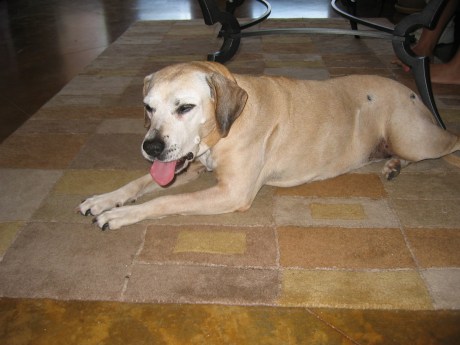
We chatter happily about our plans to get on the road, when the phone rings and we hear devastating news from the kennel owner.  Dana has been missing for twenty-four hours. The woman speculates that our dog might have been stolen.  “Lots of dog-nappers around, looking for nice dogs like yours.”  We are stunned.

The woman asks if we have a picture of Dana that we could post around the area.  Once again I give thanks for the laptop, and quickly make a notice with a picture of our sweet-faced dog.  We print copies, beg thumbtacks and tape from MJ, and post our plea to return Dana in every visible spot we can find.  And then we wait, and hope to hear, and shed a lot of tears, and pray.

On the day before we plan to leave for Ohio we receive a phone call from a woman who says she thinks she has our dog.  She had found her wandering down a road several miles from the kennel.  The woman recognized her from our poster, coaxed Dana into her car, and drove back to write our phone number down.  We all leap into the car and drive to her house to fetch Dana, who looks thin and tired but wags her tail happily.  We have no choice but to return her to the kennel for one more night.  This time, the owner promises us, she will keep Dana inside the house, and admits that Dana, with her strong pit bull muscles, had managed to pull free from the dog run in the back yard.  We cannot bear to contemplate what it would have been like to leave Opelousas without Dana.

Before we head north MJ organizes a girls’ shopping day.  I realize that I am choosing new clothes for my new life.  For the first time since leaving New Orleans I feel revived and put together, ready to face what comes next.  MJ has been so kind and thoughtful, always promoting a sense of normalcy and optimism for us.  I am indebted to her forever.

We liberate Dana from the kennel and get on the highway north on Sunday morning, September 11, each of us remembering the pain and tragedy associated with that date.  I am nervous, wondering what we are driving toward, but also relieved as we leave behind the overwhelming sadness of Louisiana for a time.
IMG_0322

Waiting

(Fourth in a series of memories about Hurricane Katrina.  Scroll down for earlier posts)

The Day of the Storm:  August 29, 2005

Bright sunshine streams around the edges of the curtains in our Houston hotel room.  Steve, Amanda and I are awake at 7 a.m.  We turn on the television but there is little to report.  The first ominous bands of rain are crossing Louisiana, and we no longer hear of the hurricane taking an easterly course.  Katrina is taking aim at New Orleans.

We try to go about our day with nonchalance, walking Dana around the hotel grounds, chatting in the breakfast room with other evacuees from New Orleans, sharing anecdotes of getting here.  In truth, we are all waiting for something to happen.

We find our way to the Galleria and shop, without interest or purpose.  On the way back to the hotel we stop at a supermarket to buy some food.  We have pored over the Sunday edition of the Houston Chronicle, and a recipe for chicken vegetable soup grabbed my attention.  Well, why not, I decide.  It sounds healthy and will keep my hands busy.  We have all the equipment needed for cooking in our Residence Inn suite.  By 7 p.m. we are eating an acceptable, if lackluster, meal of soup, cheese, chips and salsa, and fruit.  I feel that I have accomplished something in my cooking, creating a safety net of the ordinary out of the weirdness of waiting.  Reports of the hurricane are serious but not catastrophic for New Orleans, more a rain event than wind.  We go to bed early, hoping to hear tomorrow that we can return home.


The Day of Catastrophe:  August 30, 2005

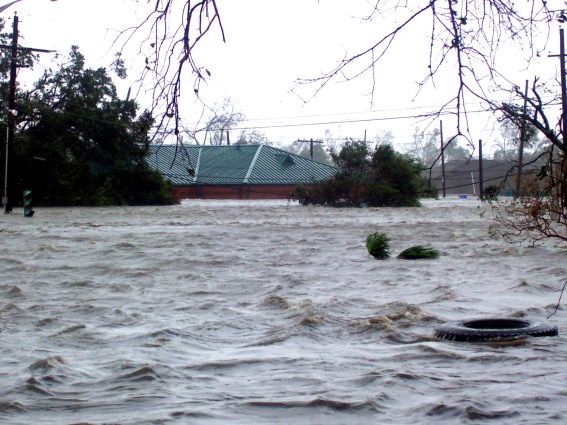
It is early in the morning, as we shower and dress, that we hear the first news of flooding.  First one levee, then another, and another, break from the pressure or are overtopped from the heavy rain.  A little after 8 a.m. we hear the reporter announce that the 17th Street Canal levee has been breached near Lake Pontchartrain.  In that moment we know there will be no going back.  If the waters of Lake Pontchartrain are now flowing over that particular levee, there is no escaping catastrophe for us.

The news hits hard but lurks in the background as we hurry to check out by 10 a.m.  It seems that Houston has been doubled by half with Louisianans fleeing the storm, and our reservation cannot be extended.  The next closest Marriott property available is a Renaissance Hotel in Dallas, three hours away.  We focus on loading the car and getting on the interstate to Dallas.  The car is very quiet as we listen to news reports of continued breaches and ever-deepening floodwaters across New Orleans.  The adrenalin pump of fear and anxiety has stilled for now.  It is time to mourn the mounting losses, to sit in silence with this new reality, to wonder how—and when—it all will end.

We check into the Renaissance Hotel.  Dana has a delightful new experience of riding an elevator up ten floors.  We all giggle at her startled look when the floor begins to rise and our laughter forces us to breathe again, exhaling worry for a moment.  It is while we are eating a late lunch that we first begin to talk about what has just happened, is still happening.  Not to each other, but with a waiter who has noticed our sad expressions, our bewildered and bereft appearance.  He listens well to our pent up grief and fear, and it is in that hotel restaurant while floodwaters still rise in New Orleans that our healing begins.  And again, when we ride the elevator with Dana, we share the beginning of our story with other hotel guests.  I hardly know how to answer when the questions come:  Is your house affected? (I don’t yet know for a fact, but yes, our house is surely flooded.)  Where will you go?  What will you do?  (I have no idea).  What will happen to New Orleans?  (silence).

Now that we are in Dallas our cell phones begin to work again for outgoing calls.  Reception had been very erratic in Houston and on the road, and still only sporadically do incoming calls get through.  It is a relief to be able to talk to my mother and Steve’s dad, and then other family members, to assure them that we are okay and to give out the hotel phone number.  We also have email access through the hotel’s wifi, and messages begin to pour in.  Communication becomes our life saver.

Steve’s cousin Mary Janet has called us, after going through quite a bit of trouble to find us.  She invites us to come and stay at their house in Opelousas, Louisiana, just a few miles from Lafayette.  A service center has been set up there for flood victims, and we will have a time and place to catch our breaths and figure out our options.  We talk it over briefly and then tell her we will arrive the next day.  I am overwhelmed by this gesture of loving kindness.

The Day of Catastrophe ends with my body exhausted from the stress, craving sleep, yet my mind has just begun to wrap itself around the enormity of the situation.  I wait in the dark for answers to my questions.  Is this true?  Is it real?  Could our house somehow have escaped the flood?  More questions that I cannot yet ask wait in the neurons of my brain.

002Flood waters rising after Hurricane Katrina

© Janice K. Shull